
Gold plated connectors in Hifi?
What are the real benefits of gold-plated connectors in hi-fi equipment?
Anyone who has been involved with hi-fi for a long time will sooner or later come across the question of which plug coating is actually the best. Terms such as gold-plated, rhodium-plated or silver-plated are particularly common. For many laymen, however, it is unclear what these differences mean and whether a more expensive plug actually has an audible effect. This article aims to address this very issue and explain why, in everyday use, gold-plated plugs are particularly beneficial for hi-fi systems – and why cables made of pure gold are pure fantasy.
Why are hi-fi connectors coated in the first place?
Connectors link devices together, and these transition points are often crucial to how smoothly a signal is transmitted. Materials such as copper are excellent conductors, but they are sensitive to environmental influences. They oxidise, lose conductivity and cause contact problems over time. That is why the contact surfaces are coated with precious metals, which are much more resistant. A good coating ensures that the connection remains stable and clean even after many years – without crackling, interference or contact problems.
Gold-plated plugs – the proven standard in hi-fi
Gold is the classic coating in the world of hi-fi. This is mainly because gold does not oxidise and offers consistently good contact quality even after a long period of time. Anyone who has ever cleaned corroded plugs knows how much trouble this can cause. Gold-plated contacts provide reliable protection against this, which is why many users find gold-plated plug hi-fi cables to be the most stable solution in the long term.
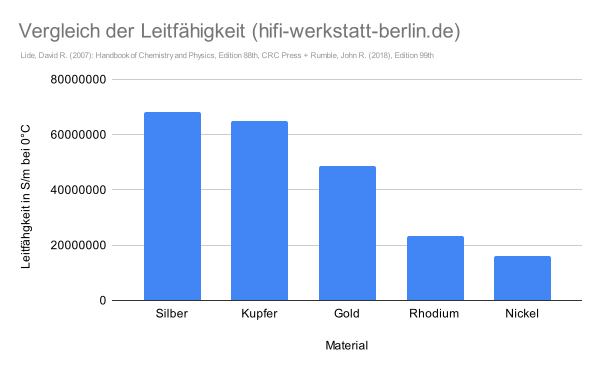
It is often assumed that gold is the best conductor – in fact, silver and copper conduct better. However, gold scores points for its durability. The thin layer of gold that manufacturers apply is usually only a few micrometres thick. This is completely sufficient to protect the plug from oxidation in the long term.

Silver – maximum conductivity, but more susceptible to tarnishing
Silver has the best conductivity of all metals and therefore enjoys a good reputation in the professional audio sector. It enables very low contact resistance, which can be particularly advantageous for long cables or especially sensitive signals. However, silver tarnishes, forming a dark surface. Many customers see this as a disadvantage, but in reality, the tarnished layer remains conductive. Silver is therefore definitely a high-quality material, but it requires a little more care when handling.
Rhodium – the durable high-end option
Rhodium is the luxury option in the hi-fi segment. It is extremely hard, highly abrasion-resistant and corrosion-resistant. These properties make rhodium-plated connectors particularly interesting for users who frequently plug and unplug their cables, such as in modular systems or studios. Although its conductivity is slightly lower than that of gold or silver, its mechanical robustness is the decisive factor here. Rhodium is also often chosen for its cool, metallic, elegant look.
Nickel – the everyday standard for many devices
Nickel-coated plugs are often found on standard cables in the mid-range and low-price segments. Nickel is stable and corrosion-resistant, but is less commonly used in the hi-fi scene because it does not provide the same contact quality as gold or silver. However, nickel is perfectly adequate and reliable for simple applications. Those who want to get the most out of a high-quality system usually opt for higher-quality coatings.
Why cables made of pure gold make no technical sense
Myths about supposed ‘solid gold cables’ that are supposed to be particularly high-quality continue to circulate. In fact, this concept makes no technical sense whatsoever. Gold would be impractical as a conductor material because it is too soft mechanically and conducts less well than copper or silver. Even if one could afford it, such a cable would not offer any sound advantages – on the contrary. In practice, the optimal combination is therefore a high-quality copper conductor, often of high purity such as OFC copper, combined with a robust coating on the plug contacts, frequently gold. Pre-assembled cables are available, for example, from Sommer Cable, Eagle Cable, or Supra Kabel. However, we can also manufacture cables specifically to your specifications. Please feel free to enquire.
How important is the coating really for the sound?
In practice, the coating primarily affects the reliability of the connection rather than the sound itself. Poorly coated or corroded connectors can cause audible interference, noise or contact problems. A stable contact surface is therefore essential, especially for high-quality hi-fi systems. For most users, gold-plated connectors offer the best overall package of durability, stability and value for money. Silver or rhodium are particularly worthwhile for very high-quality setups or special applications.
Conclusion – Which plug coating is most suitable for hi-fi?
For most users, gold-plated hi-fi connectors are the best choice. They are durable, resistant to oxidation and ensure permanently stable signal paths. Silver and rhodium each have their own specific advantages, but are more interesting for high-end or professional users. Solid gold cables, on the other hand, clearly belong in the realm of myths. Some high-quality plug manufacturers include: Oehlbach, Rean, Hicon, Amphenol, Neutrik or WBT.
If you have any questions about your hi-fi system, cables or repairs, we at Hifi-Reparatur Berlin will be happy to advise you personally – competently, comprehensively and practically.