
Capacitors in old Hifi Equipment
Recapping in hi-fi – Why capacitors are so crucial in old hi-fi equipment
Anyone who has owned classic hi-fi equipment for a long time or is familiar with older amplifiers, tuners or receivers will sooner or later come across the term ‘recapping’. Particularly with equipment from the 70s, 80s and 90s, it is often pointed out that capacitors age and should be replaced. For many laymen, however, it is unclear what exactly this means, what problems ageing components cause and why replacing them brings such significant improvements in sound and technical performance. This article aims to address precisely this issue and explain why capacitors in old hi-fi equipment are one of the most important components of all – and why professional recapping protects these classics from sound loss and serious damage.
Why ageing of capacitors is unavoidable
Capacitors are among the components that are installed in large numbers in every hi-fi device. Electrolytic capacitors, known as Elkos, are found everywhere: in the power supply, in the preamplifier, in tone controls, filters, power amplifiers and even in the tuner section. They work by storing and releasing electrical charge – and this is precisely why they need a liquid electrolyte. Over the decades, however, this electrolyte slowly evaporates. As a result, the capacitor loses more and more of its original capacity.
This process is unavoidable. Even if the device has hardly been used, the components age simply due to the passage of time and temperature fluctuations. The values then often deviate significantly from what the developer originally intended – and this has a direct impact on the sound and functionality of the device.
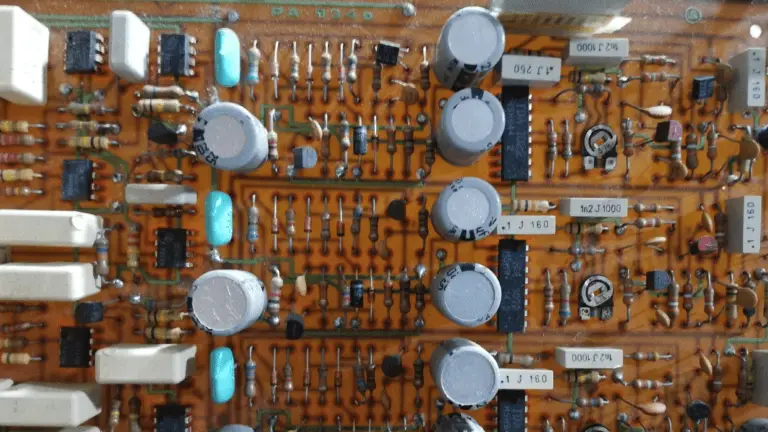
How aged capacitors affect sound quality
If the capacity of a capacitor decreases, the electrical properties of the circuit change. Especially in filters and tone controls, this means that frequencies are no longer separated as intended. Many hi-fi owners are familiar with this phenomenon without being able to explain it: the bass sounds weak or thin, voices lose their body, and trebles become unpleasantly sharp or unstable. This often gives the impression that the system has ‘aged’ or is ‘no longer as musical as it used to be’.
In reality, this is usually because capacitors are no longer performing their function properly. The filter frequencies shift, circuits become unbalanced, and the amplifier loses dynamics, precision and warmth – all typical consequences of ageing electrolytic capacitors. The only solution is to have them replaced as part of our service.
Why power supplies are particularly sensitive
Ageing is even more noticeable in power supplies. Here, capacitors are designed to smooth out voltage fluctuations and prevent humming, noise or voltage spikes from reaching the rest of the electronics. However, if an electrolytic capacitor no longer has sufficient capacity or its internal resistance has become too high, the power supply unit will no longer operate stably. This often manifests itself in humming noises, unstable operation or sudden dropouts.
It becomes more dangerous when voltage spikes are passed on unfiltered. This can damage transistors, rectifiers or integrated circuits. Many costly defects in old hi-fi equipment can be traced directly back to aged capacitors. Timely recapping reliably prevents such damage.

Audio electrolytic capacitors compared to normal electrolytic capacitors
Special capacitors, known as audio electrolytic capacitors, are often used in audio equipment. They differ from standard industrial capacitors in that they have a lower ESR value, more stable frequency characteristics and significantly lower distortion.
The ESR – i.e. the internal resistance of a capacitor – increases significantly in old components. A high ESR means that the capacitor reacts much more slowly and no longer works accurately. This is particularly problematic in the signal-carrying range, as it leads to tonal colouration, sluggish transients and an overall less lively sound image.
That is precisely why we only use high-quality capacitors such as ELNA Silmic for recapping. Nichicon Fine Gold or Mundorf, which are specially designed for audio applications. They have a very low ESR, are significantly more durable and ensure that the device fully regains its original sound character.

Recapping as a treat for sound, stability and service life
Professional recapping can have an amazing effect. Many owners of older amplifiers are surprised at how much clarity, dynamics and power their device suddenly has again. The sound becomes more lively and relaxed, the bass gains precision, and voices sound more natural and cleaner. Operational reliability also increases significantly: humming disappears, the device becomes less warm and reacts much more stably to load changes.
One often gets the impression that the device has been rejuvenated by decades – and that is precisely the effect that fresh capacitors bring as part of our service.
Conclusion – Why recapping is essential for old hi-fi treasures
Capacitors are among the components that almost always age in old hi-fi equipment. They are crucial for sound quality, stability and safety. Recapping is therefore not a cosmetic measure, but a fundamental technical restoration. It protects the device from expensive defects and at the same time restores its original sound – just as the manufacturer once intended.
If you are unsure whether your device needs recapping or what measures are appropriate, we at Hifi-Reparatur Berlin will be happy to advise you personally – in a clear and honest manner and with high-quality components that will keep your classic devices in good working order for many years to come.